Sunday, June 5, 2016

Day 16: Rest Day in Burgos - Part Two

My second rest day in Burgos and I am completely relaxed and able to truly enjoy where I am. No pilgrims rustling their plastic bags at 0500 or pilgrim rush hour for the first hour out as people jostle to pass each other ignoring the spectacular sunrise. There are aspects of this hike that don't sit well with me. It is definitely not the Appalachian Trail, or even the Mason Dixon Trail!

Burgos Cathedral, interior courtyard 

My goal for today was to attend Pilgrim Mass in the morning, take a tour of the cathedral, and to climb the hill to the Burgos Castille ruins. I headed to mass as the eight o'clock bells tolled and met again a beggar at the door of the chapel. People bustled past her, hauling their backpacks in so as to make a quick escape after service. There are a few beggars here, those holding pictures of their needs - a surgery, food, a home. I bent down to drop my change in her beggars bowl and to touch her hand. Our eyes met and she said Gracias three times. "If you cannot find Christ in the beggar at the church door, " said St. John Chrysostom, "Then surely you will not find Him in the chalice."
The mass went very fast. I stayed for the longer one at ten. This time there were the readings, the Gospel, and a homily.  I took communion and listened as the throaty old pipe organ came to life, rumbling through the church pews. I stayed a while longer and prayed for a friend, dogs, and a family who has lost their grandmother. Then I headed out into the square just in time to be practically thrown off my feet by the noon bells! Nothing can possibly prepare you for this fifteen minutes of giant bells doing somersaults in their tower, spinning over and over on their axles. People stopped and stared up. Children clasped their hands to their ears. Dogs barked and howled!

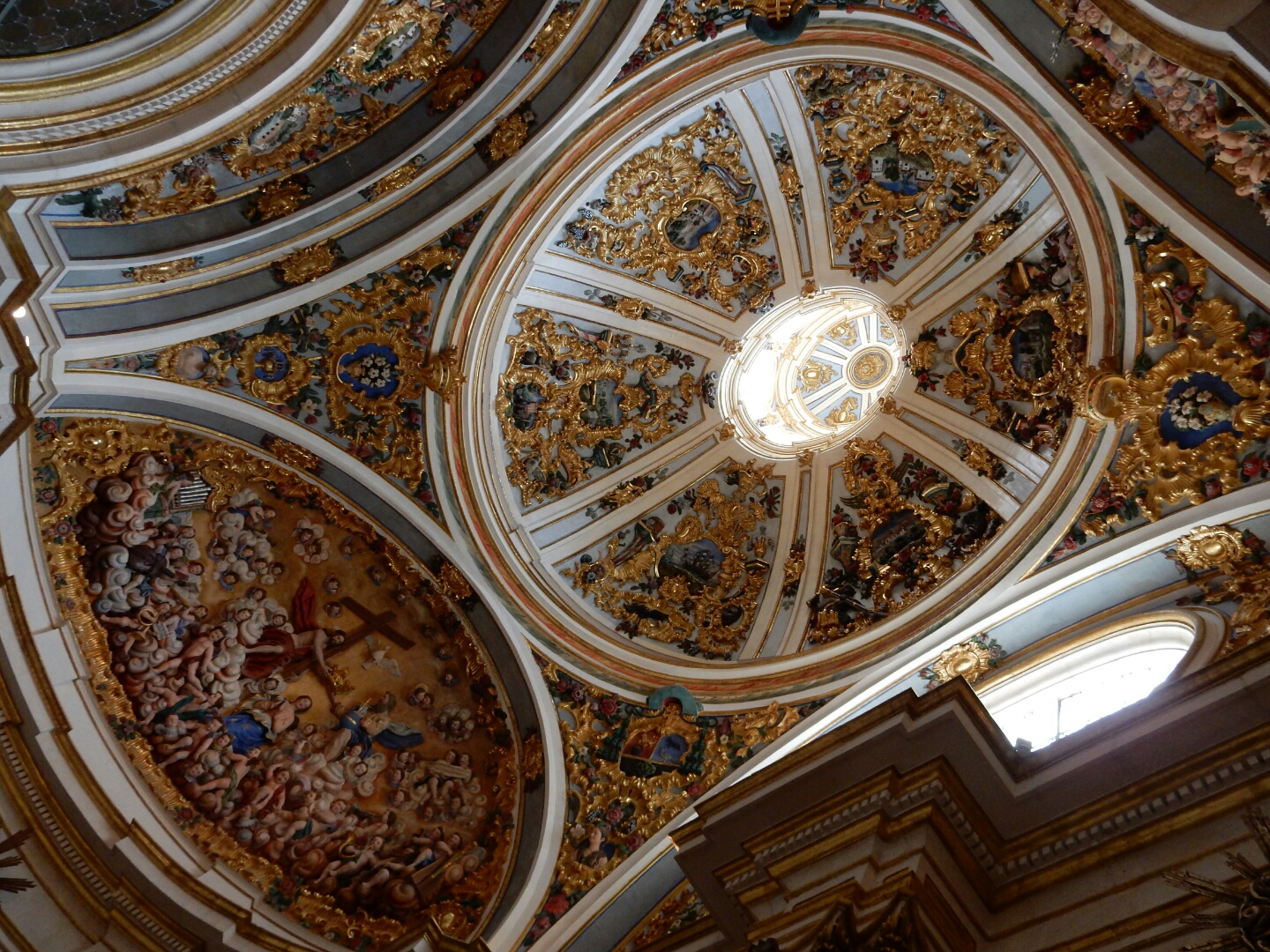
So. Many. Domes.

I got my ticket for the cathedral tour and received my handy-dandy telephone things that featured a push pad of numbers that you could dial at each stop. At first the British narrator was interesting at stops 1-8. Chapel after chapel, dome after dome, sacristy then more sacristy.

Baroque and more baroque and sleepy.
Then for stops 9-30 something the voice changed to a sleepy lady Brit. She sounded like a sleep tape I once used. Oy. Every statue I looked at, holding her drifty voice to my ear, I yawned at. Gold-guilded retablos, gold-guilded throne things, gold-guilded everything. Oh the lavishness of it all as people begged at the doors. I found a handy bucket to toss my phone thing in and went for a safari. I decided to look for birds and animals in the artwork. It became a game I really enjoyed. Wide awake!

Griffons on the Golden Stairs.

Beloved terrier at a Queen's feet.
I noticed that mythical animals were given the job of guarding openings like doors, stairs, and passageways. Dragons and griffons perched high up. Lions and dogs laid at the feet of alabaster death bed figures. Dogs outnumbered lions. But there was a bear.

A hound at the feet of a knight.

A war dog at the foot of a king.
An eagle kisses a dragon - or maybe bites it?
Griffon guards the door to the cloister walk.

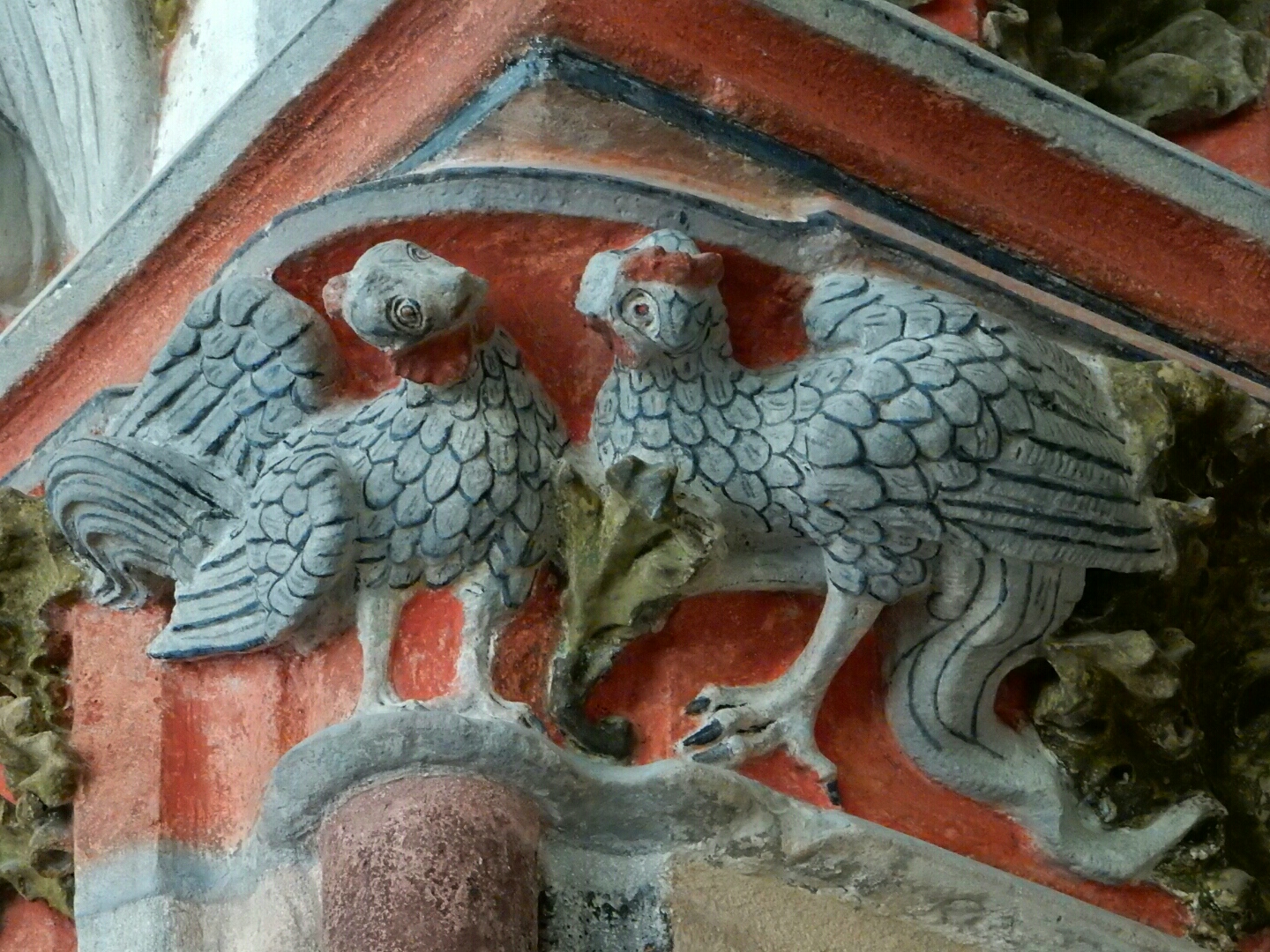
Peacocks display atop a painted plaster column. 

A pig holding a grape leaf.
I wandered round and round the cathedral looking for animals as tourists took hundreds of pictures of domes, altars, chapels named for every benefactor in Burgos since it was a Roman temple. I came across domestic animals in carvings and paintings. St. James was transformed from pilgrim to Slayer if Moors riding his glorious Castilian war horse. Another legend to contend with.

Manger scenes included cattle and donkeys. Joseph looks tired!

Donkey and cow drink from a watering trough.

From the Reconquest, the Legend of St. James the Moorslayer 

Castilian war horse prized for its courage in battle .
A large gallery contained a hundred large paintings of various Biblical scenes but I kept my eye open for how creatures were portrayed. Most of the paintings showed all the different ways to crucify a man, or skin him alive, or pierce him with forks and arrows. There was so much graphic tortured and death among the scenes of Christ's death and the death of martyred saints that my stomach was turning. Oh, religion. Why? But there were things with wings as well.

Holy Spirit descends as a white dove.

White dove scenes usually don't include torture.

St. Martin and the birds.
My favorite bird spotting in the gallery was of St. Martin for whom our migrating martins are named. This saint's legend is complex but in a nutshell, he had rejected the life of a warrior for that of a wandering cleric, and in so doing, found ways to convert Druids and other pagan people to Christianity by explaining Christ's lessons through nature parables that combined tribal beliefs about death and rebirth. He was a very humble man who found friendship with those that the Church scorned and persecuted. The birds have been associated with his feast day and it us said that as he lay dying, great clouds of migrating swifts, swallows, martins, and nighthawks swirled above him to lift his soul to heaven.

Mark and Bell.
I left the cathedral and began my walk up to the castle ruins, but didn't get far when I spotted a pilgrim and his dog. If course I had to go over and ask to pet her. Mark was from Toronto, on his way to Santiago with his wife meeting him every night at a casa rural. He explained that the dog began to follow him a week ago. "I made the mistake of feeding her, " he said. "She waits each morning for me to come out of the house. One day my wife gave her a ride back to the village she came from, but no one claimed her. We're trying to figure out how to bring her home. We've named her Bell."

Bell.

Day 15: Rest in Burgos - Part One

Burgos offered me a day of rest and ease, that helped immensely with persistent blisters that have been bothering me since the big rainstorm coming in to Zubiri a long while ago. Every morning I cut my gauze, apply ointment, tape everything up and walk fifteen to twenty miles. Every afternoon I pull the whole mess off, shower, sit in the sun and let my aching feet dry in the sun. Today, though, I just got up, put in my walking sandals with a nice cushy pair of socks and walked around Burgos without my backpack. I felt like skipping!


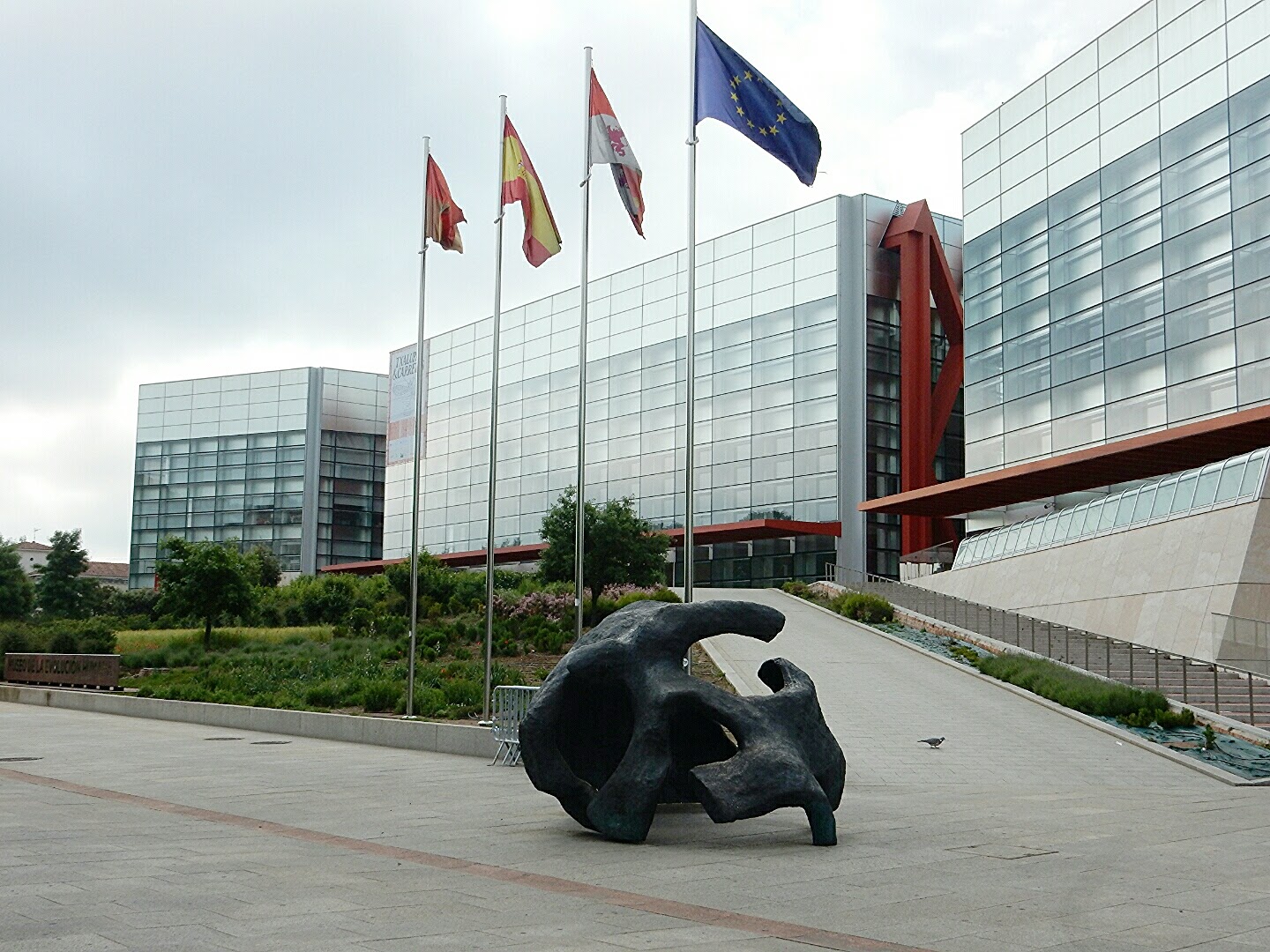
Museum of Human Evolution 

First stop, top of my list, was the Mussolini de la Evolucion Humana where I roamed for hours among the displays of the complex cave systems of Atapuerca and learned about the remarkable finds made there. The large, modern museum and research complex stands facing the large, Gothic cathedral across the river. Quite a paradox of positioning, although today's Pope Francis would most likely celebrate the view: science and faith as complementary books of the story of man.

Four floors of evolution - a Darwinian's dream!
I was imagining St. Jerome, the most learned of the early Latin Fathers, strolling the floors and smiling. He saw no conflict between the Greek system of scientific thought and natural history and his faith. When I entered the second floor that featured Darwin's home study, his cabin aboard the Beagle, and a vast collection of his writings on the mechanics of evolution, I imagined St. Jerome having a cuppa with Charles and getting on well over things like natural selection, genetic sequencing, and evolutionary trees.

Fantastic, life-size wall murals of paleolithic fauna of Iberia. 

Many of these species are found in fossil abundance in Atapuerca.

I am forever grateful to my high school biology teacher, Terry Leef, who was able to offer an AP course in Evolutionary Biology at our Catholic High school.  He had us reading scientific journals, complicated theory, and debating the naysayers long before the popular anti-science religious movement of conservative Bible belt politics. That was a long time ago, but it instilled in me a real love of scientific argument and the spirit of discovery that Atapuerca reignited while on my walk.

A new ancestor - Homo antecessor

Miles of caves contain ages of artwork that spans 50,000 years of occupation 

H. antecessor and child stroll Burgos
The history of humankind in Spain is rooted in tribalism and cultural identity that even today marks the influence of Neanderthal man, who introduced art, music, reverence of the dead, and seasonal ceremony. There is theory to suggest that the appearance of H. sapiens, coming from our long trek up through Africa, may have completed with our Neanderthal cousins of the north, fought them, or intermarried with them. DNA reveals as much. But researchers in the Atapuerca basin know that they lived near each other, camps sometimes only a few miles apart.

St. Jerome, scientific scholar of the Church, Cathedral collection.

From the blending of species, new cultures emerged. Over tens of thousands of years, the Iberian tribes fathered the clans of early Celt-Iberians and the wild Basques, people of the sea and the mountains. The Moors swept north and brought their traditions of irrigation, horticulture, astronomy and science, the building arts, and medicine. Indo-Asian tribes arrived from the East and brought agriculture. It took the Romans 200 years to conquer Spain, and though they occupied the Iberian Peninsula for 800 years, the fierce tribes of the north and south held out against them and traditions, languages, music, and independence endure.

Saturday, June 4, 2016

Day 14: Atapuera to Burgos

I strolled out of Atapuera up a mountain and looked back over a Savannah of oak, plains, and ravines. How much more to the human story must be hidden in the caves here? There are hundreds of scientists working here and in the research labs in Burgos on the fossils found here and around Spain. I couldn't wait to get to Burgos to see the Museum of Human Evolution! I think I was half-jogging! Science!

Monument to our Neolithic and Paleolithic ancestors in Atapuera.

Pilgrims walking through the Atapuera plain at dawn.

Over a million years of human history in the caves below. 

The Castilian Serengeti continuously occupied by human species for 1 million years

Over the low hills we hiked, the Germans out in front, followed by the speedy Japanese, the French men striding along, the Danes, then me - toddling this way and that to take pictures of this ancient Serengeti-like landscape. Underneath it all were the caves - hundreds of miles of galleries, sinkholes, and karst shafts- filled with sediments that contain pure ancestry and the fossils of plants and animals we ate, tamed, harvested, and gathered. I imagined mammoths, giant bears, wild horses, and wolves. Then up over the ridge and - bam! There's religion, again!

Wait... where's my science? 

Spain is religion. You can't escape it. It holds the relics and legends of more saints that anywhere I can think of. Loyola the Basque. Teresa the Castilian. Juan of the forests. Every town has it's saint and it's own special dancers to honor them with enormous floats, costumes, songs - multiple holy days and festivals. I think Spain was Catholic before Catholicism was ever a thing. Symbolism, ritual, ceremony, the stuff of fantastic stories and wild legend. Santiago himself is mostly legend. There's no evidence he was actually ever in Spain but the stories of the paths of stars, beheaded apostles, faithful companions, and the ever-present scallop shell is laid out along this path like a continuous lines of ribbon stitched to the land. People believe, and have been walking The Way since the 800s to atone for their sins, mark their passage through life, and plead for mercy at the foot of Saint Jacque. The Frenchmen up ahead had a catchy pirate song about Captain Jacque the Saint of Stars that kept drifting back until the sun finally rose.

Rosie the one-armed T-Rex was found near here. So here is her monument.

I walked through a few tiny towns with their massive churches and thick-walled bell towers. Bells clanged the hours, quarter hour, half hour, quarter of. Bells don't ring in Spain. They clang, bang, crash, gong. They don't play pretty tunes or chime at all. They holler and shout. Heavy, metallic, meaning business.

Burgos! 

Finally I came into the city through an industrial area that was mostly rubble. This is Spain too. Rubble piles of Roman occupation, mud-brick peasant walls, stone, cement, twisted metal of wars and economic distress. I was followed by two Camino dogs, who hoped I would give them food. But I knew better than to feed them, lest I have two dogs to follow me to Santiago! Once in the modern part of the city I looked for the police department. I wanted to get a stamp for Pat, in his memory. Two miles later I found it. The Chief was very glad to see me. "Not many pilgrims come off the Camino so far for this stamp!" I told him about my friend, killed in the line of duty this past February. The department chief has walked the Camino three times from SJPP and he knew about honor walks. He made quite the ceremony of getting the official stamp!

A stamp from the Chief if Police, Burgos. For Pat.

I had to get directions back to the Camino and everyone I asked was so kind. The old people, especially, were so happy to help a pilgrim. With their help, I walked through the old city gates and up the hill to the municipal albergue. I was exhausted and done after 15+2 miles. I stood in line for check in, dreaming of a shower. There was the Welshman, Mike Peterson, just ahead of me. Happy reunion!

City Gate to Old Burgos!

Welcome home for tonight!
Four-bunk cabin.  150 beds in this city albergue!
Cafeteria, laundry, library down below.
View of the Cathedral from the municipal deck!

Friday, June 3, 2016

Day 13: Villafranca Monte Oca to Atapuerca

Today's section included ten miles of forest hiking through the frightening wilds of the Oca Mountains! Well, they were frightening for pilgrims passing through in the Middle Ages. Gangs of robbers hid out here - and worse - making the full day trek treacherously scary. Songs were written about the Oca. Death songs. But not today. Just the birds!

Oca Mountains.
I walked mostly in a long string of solo women hikers through the defense woods. I could hear the clack m of hiking poles far behind me and now and then glimpse a backpack ahead of me. Then out of the woods came Louie from Belgium, fresh from his morning "break."

Fern and oak.
Louie began his hike in Belgium almost two months ago. He wears a felt woodsman cap with a felt scallop shell sewn to the upturned brim. His round glasses and grey beard give him the look of Sean Connery in Name of the Rose. I told him this and he cracked up. He's a retired agricultural professor so we have a lot to talk about.

On and on, up and up, through the Oca hills.
We came into the town of San Juan de Ortega and stopped to have a snack. I peeked inside the Iglesia San Juan de Ortega and was blown away. Because of the Jubilee Year of Mercy, the Holy Door was standing open do I walked through it, then back out to wave Louie inside, then back through again. A nicely dressed docent gave me a hard stare. Oops. No extra holies for me!


The Holy Door is open.


Saint John de Ortega is in this simple stone coffin.

The fancy death cask is strictly ornamental.

There are so many legends surrounding San Juan but the one that everyone is paying attention to is his ship's sinking in a Mediterranean crossing returning from Jerusalem pilgrimage. As the ship of hundreds of pilgrims began to take on water in a fierce storm, San Juan prayed to San Nicolas of Greece, asking for salvation. The pilgrims survived the terrible sinking, washing up on shore barely alive. San Juan was so thankful that he travelled to this place, the most dangerous crossing on land for pilgrims to Santiago, with the intent of making a road through the frightening forest and employing guardians, warrior monks of the Holy Orders - Knights - to escort up to 18,000 pilgrims a year to his hospital here. I knelt to pray to the good saint and a women in a head scarf knelt next to me. She prayed in Arabic! When I finished I waited for her at the Holy Door. She spoke great English and explained she was a professor of Islamic Studies in Madrid. She prayed to San Juan for those crossing the Mediterranean this year, fleeing war. I kinda cried a little. She hoisted her pack like the rest of us, and continued on her way.

Meet your ancestors!
I was lost in thought for miles then looked up and saw the sign to Atapuera! The greatest paleolithic sites in Europe are in these hills and I was straining to see where the digs were. I wasn't disappointed! Paleo scientists from all over the world are working this landscapes, which has yielded 90% of all human fossils discovered in Europe! Woohoo!

Standing stones mark a paleolithic village site.

The town is tiny. Only two albergue and they were sure to fill up fast. A very handsome Japanese hiker jogged up beside me and that I was very fast and would beat everyone into town. I said no, that I just enjoy starting very early in the morning. But we were the first! We hiked to the top of the hill, over looking a broad wetland and could see the enclosed building in the distance that has been erected over the most important dig site. And there, in sight if the Atapuera digs was an albergue built into an barn ( circa 1650!) so of course we had to check-in!

La Hutte Barn Albergue 

By 1pm it was full! 

Wednesday, June 1, 2016

Day 12: Belorado to Villafranca Monte de Oca

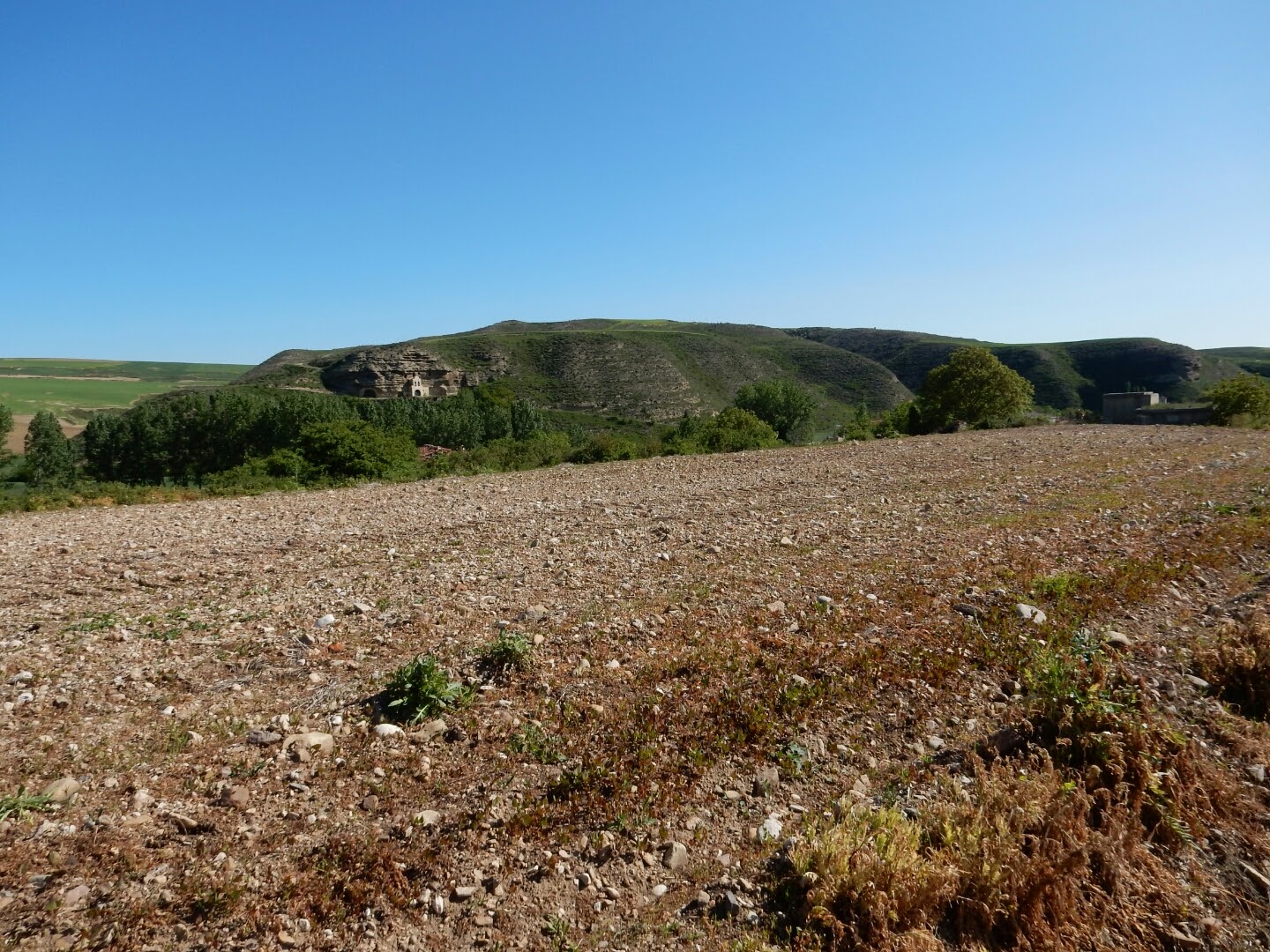
I walked through cave country imagining tens of thousands of years of human occupation, scanning the cliffs for openings that would make a good home, a church, a retreat, a trap. I was not disappointed! I only did seven miles today, partly to spend those precious morning hours birding along river banks and woods, and partly to just take in this great landscape of rock, field, and hill.
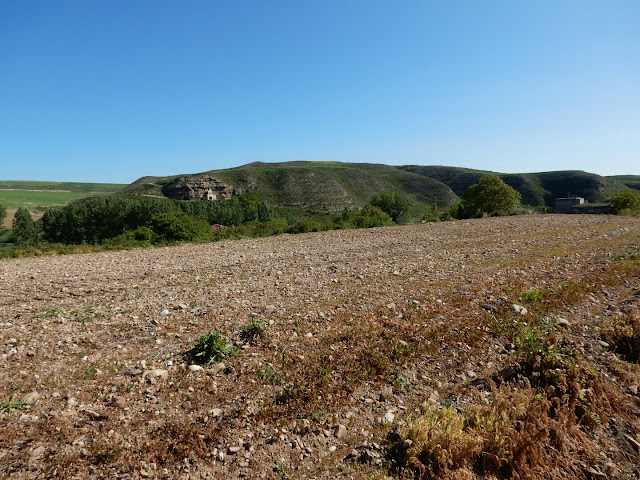
Cave country! 
Most pilgrims respect another's preference for solitude, but today I met the one, a fellow American, who didn't quite get the idea that the Camino is a deeply personal experience. Sure, early Catholics went in their search for relics and collected indulgences, and modern pilgrims can check boxes off as they encounter religious sites of significance (travel companies will give the check-off list). But for most pilgrims I met, the experience of the Camino is to enjoy this rugged country with its reds, and browns, and greens - it's unbelievabley kind people who greet you with their handsome smiles. But this particular pilgrim from America wasn't buying it. "Nobody speaks American here." And so began my one hour of penance...

Rock shelters and a Hermitage.  
She was my age, accompanying her 25 year-old daughter to "protect her from Mexicans." I thought I was hearing things. Her daughter, plugged into her iPod was oblivious to the conversation. She didn't think it wise that a young girl travel alone in a foreign country. Never mind the hundreds of women who do the Camino alone each year. She talked about being concerned because a woman from Arizona was killed here last year. "Yes, on average 17 people die on the Camino each year, " I said helpfully. " My god what a violent place!" she said.

I check another stork nest for my tally - up to 32.
I explained that last year's murder was an anomaly, that this kind of crime was really quite rare. Most people are hit by trucks and cars crossing busy roads or have heart attacks or strokes due to the excursion. "Well," she said, " I didn't know that. No one tells you anything. They can't speak American. " I tried looking for birds, walking painfully slowly, hoping she would want to catch up with her daughter. But....no.

Cliff-built church.
"This place is pretty empty, don't you think? Wouldn't it be a good idea to deport all those illegals here where they understand the language? It's a Mexican country, right?" I wanted to run and hide. Was she serious? Meanwhile the beautiful cliffs and ornate cave churches passed by, unnoticed by this woman, even as I tried to point them out. I offered her my binoculars. She looked up through her head net and squinted into the sun. I suggested she enjoy the landscape. " Human evolution is an incredible story," I said, maybe too enthusiastically. "Oh no! That's what Common Core wants to teach our kids!" I was done. I started limping. Totally faking it.

Gothic churches mark every town.
I had to ask. "Do you have a reason for doing the Camino, besides protecting your daughter from Mexicans?" She gave it some thought. A huge, massive gothic church came into view and she pointed at it. "Jesus!" I wasn't sure if that was her answer. By now my fake limp had become worthy of a Hollywood movie stunt. I hobbled to the church where there was a bench. I collapsed on to it and said "Oh, this tendonitis!" She looked at me, then ahead to her oblivious plugged-in daughter now a good half mile ahead. "Jesus and Donald Trump will make America great again." She left me fake-groaning on the bench and fast walked to catch up. I ducked inside the church and asked God for forgiveness . Then I went back to birding, blissfully alone all the way to Villafranca Monte Oca.


So here are my thoughts for today:

All of the Americans I've met so far on this hike have been intelligent, aware of Spain's complicated history, and very excited to meet and be with people from all over the world. When we visit another country, even if we can't speak the language, we learn something valuable about each other's cultures, values, and hopes for the future. The lady I met today was, like the murder of a pilgrim last year, an anomaly. She carried all of her fears and biases heavily on her frame like an extra 60 pound pack. This weight is unnecessary and most painful. I prayed that she and her daughter might shed some of their ignorance and open their eyes and ears to this incredible experience.

The Camino pilgrim experience is meant to be highly personal -some like to say spiritual, others say religious. The top three questions when meeting someone new ( this can mean a dozen times a day) are:

What is your name?
Where are you from?
Why are you doing the Camino?

I haven't heard anyone say they are doing it to gain access to heaven, or to see relics of saints, or to do penance - though there is one young man walking with a social worker from Norway who was given the Camino as his alternate prison term. What I have heard a lot of is to find themselves again, as if they've become lost. I can relate.

The Camino is not easy. It is not a fixed trek from point A to point B everyday. You have to make decisions and prepare. Sometimes the way is brutally long. Sometimes you run out of water. The next town might be deserted when you thought you might find a place to eat or sleep. There are hard days of hiking steep ups and downs, long boring days of dust and sun, or mud and rain. There is no tour guide to take you to your hotel and seat you at the restaurant. You don't understand the menu and you find your stomach rebels at certain foods.


Spain is a country that can barely contain itself. There are the fiercely independent autonomous regions. There are four official languages. There are as many ways to say Hello, Good Day, as there are innumerable dialects and you will always pick the wrong one. But here's what the Camino teaches you, stumbling, shuffling, aching pilgrim: the Spanish people love you for trying, and happily answer with a smile as big as the sky "Buen Camino!" They invite you into their homes (casa rural) and offer their kitchens to cook a dinner. They don't care if you are German, Italian, Brazilian, Canadian, Danish, Irish, Scottish, or Hungarian. They really don't give a rat's behind if you think your country is the greatest or the most powerful. They want you to rest from your hard day, come sit and read, relax. Stay today and if you like, tomorrow. But don't wear out your welcome. Keep going.


The Camino is not about Santiago de Compostela at the end. It's a powerful stop along the way, yes. But it's about the continuation of this journey beyond the Cathedral and the Pilgrims Mass and the mighty, smoke- belching incense burner that flies high over your head. This is how God wants us to be - in and of the world, to love it now, here, the hard parts especially. The Camino is a metaphor for our journey here on Earth. A journey from hiding in caves from packs of wolves and running through gangs of thieves-  to realizing, as I hope lady in her head net does, that we are all in this together.   What better way to walk the path of life than in kindness and humility for all we are given every day.